A rainy afternoon, spent watering the plants in the TFS studio, inspired this post. May these tips help you grow more familiar with the plants you have – or invite a new variety into your home.

Every plant is different and getting to know their preferences is an honor and a joy. Tap through each plant for tending tips:

Asparagus Fern

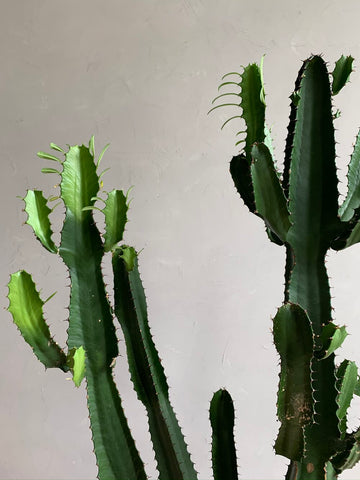
African Milk Tree

Philodendron Xanadu

Narrow Sword Fern

Fiddle Leaf Fig

Arrowhead Plant

Parallel Peperomia

Banana Leaf

Dragon Tree

Rubber Plant
Share your plants with us .
]]>Tips from our team to your garden - organic, effective pest repellents, fertilizers, and more.

Crush rinsed, cleaned eggshells. Place them around the base of the plant to deter slugs, or mix them into the soil to increase calcium content.
Soak banana peels in some water for a few hours for use as a quick fertilizer.
Pour coffee grounds and leftover black coffee around plants that like acidic soil. It also deters slugs, snails, and other pests.
Flowering trees and shrubs: hydrangeas, azaleas, dogwoods, magnolia
Vegetables: sweet corn, cucumbers, lettuce, leeks, eggplant
Herbs: lemongrass, thyme, rosemary, basil, oregano
Add 2-3 tsp of dish soap to 1 gallon of water.
Spray every 2-3 days until the infestation is gone.
Sprinkle ground turmeric, or apply a quick paste (made with a touch of water), to heal a damaged plant as it has antibacterial & antifungal properties.
Sprinkle ground cinnamon on the topsoil of both indoor & outdoor plants as a fungicide. Cinnamon reduces the growth of mold and mildew on the soil and also keeps away mosquitoes, gnats, and mites.
Mix 1 gallon of water with 3 Tbsp vegetable oil.
Funnel into a spray bottle.
Spray on leaves, front and back.
Mix 1 gallon white vinegar, 1 cup salt, and 1 Tbsp dish soap.
Funnel into a spray bottle.
Spray on leaves and stems of weeds, but avoid saturating the soil!
Add a nourishing organic boost to your garden and houseplants with Arber, a science-backed line of plant wellness products for indoor and outdoor green spaces.
Organic Plant Food, Organic Bio Fungicide, Organic Bio Protectant, Organic Bio Insecticide are available in our Garden Collection here.

Cheers to your garden thriving, and your future harvests, whether vegetables or blooms. Show us what you grow!
]]>We’ve condensed our own years of trying and testing into a collection of versatile, quality essentials, all made in Japan.

Our floral clippers and floral pin frogs are perfect for precise floral arranging and practicing ikebana.
Japanese craftsmanship is unparalleled in the world of tools. The Japanese tool industry grew out of a long tradition of swordsmithing katana — or close-combat samurai swords. Precision blacksmithing and quality design have created a legacy of durable, reliable tools, from gardening and cooking to floral arranging and woodworking.
For 鶹, we’ve collected our core necessities for floral arranging and gardening. We hope these tools bring you hours of enjoyment and creativity.

Hori means ‘to dig’ in Japanese, but these nimble and versatile garden knives do that and more. Sometimes referred to as a weeding knife, our Hori Hori Knife is also ideal for digging holes for transplants or bulbs, dividing, and pruning. It is crafted with one serrated edge and one smooth, using Japanese blacksmith heat treatments and techniques.
These razor-sharp and lightweight pruners are a must-have for the home gardener. Perfect for light- to medium-duty pruning, these shears will be your go-to tool for deadheading roses, perennials, and annuals. Use for shaping shrubs, ornamentals, and fruit trees. Excellent for reviving old bouquets with woody stems and foraging branches from the woodland for vase forcing.
Perfect for small gardening tasks, houseplants, or tending to seedlings. A great size for little green thumbs, too. Both tools are hand-crafted, using Japanese sustainable beech wood for the handles and Japanese stainless steel blacksmith heat treatments and techniques.
Features hand-sharpened edges for optimal depth and angle for slicing through soil and roots with ease.
Features hand-formed prongs creating optimal angles to make your weeding and cultivating tasks easy.
A kenzan, commonly known as a pin frog, is the essential tool used to create Japanese-inspired ikebana floral arrangements and is also the foundation of any architectural arrangement. Ours are sharp and precise, with a sturdy weight and removable, non-slip rubber base.
Our original — one of the first tools we created for TFS. With teflon-coated carbon steel blades and thermoplastic elastomer handles, the ergonomic design remains comfortable in the hand as you work. Ideal for trimming flowers, pruning plants, or cutting herbs and vegetables from the garden. Truly, the only pair you will ever need.

Every gardening endeavor takes a bit of trial and error. Every wilted leaf has a lesson. Every unproductive plot yields tips for next season.
Our team rounded up some recent learnings from their gardening attempts – successful and otherwise! Scroll on for tips.
“Succession planting! You can get pretty sophisticated about staggering maturation dates, but the simplest way to make sure you're harvesting all summer long is to space out plantings of any given vegetable by 2-4 weeks.” – Rosalie
“Mike and I currently have a window herb garden (TFS herb seeds!). Only tip I can think of for these is to make sure they are in a sunny window spot and that they are in pots with drainage holes to make sure they aren't over-watered! We love our Genovese Basil for fun summer cocktails.” –Julia
“Companion planting is also helpful. Certain vegetables like being grown near each other in gardens (tomatoes, basil, peppers | corn, beans, cucumbers, peas | spinach, strawberries), and planting friends with friends can help increase yield, decrease disease, and limit pests!” – Caitlin
“I don’t get a ton of direct light each day due to a huge tree that shades my yard. I have the best luck with leafy greens and herbs. Arugula is my favorite. I did try peas this year to see what would happen and they’re already growing!” – Sierra
“I have a shared garden with my neighbors and we've dedicated a section this year to different varieties of peppers! It's my first time planting them but I've learned how important it is to space peppers more than 12 inches apart so they have the proper room to grow. Needless to say with all of the varieties, we have quite a large pepper garden!” – Olivia
]]>Whether you’re starting a kitchen garden, edible flowers, or herbs, proper seed starting will set you up for success. You can technically start seeds indoors throughout the year, but to determine which dates are best for your zone.

SUPPLIES NEEDED
Watering can
Gardening gloves
Trowel
Seed starting mix
72-cell plug flat
Flat tray
Clear lid
Pots
Seeds
Optional:
Extra labels
Heating pad
Grow light

STEP 1
Add your seed starting mix to a large bowl or planter, thoroughly moistening with water.

STEP 2
Fill the cells of your seed tray, gently tamping down to eliminate any air pockets.

STEP 3
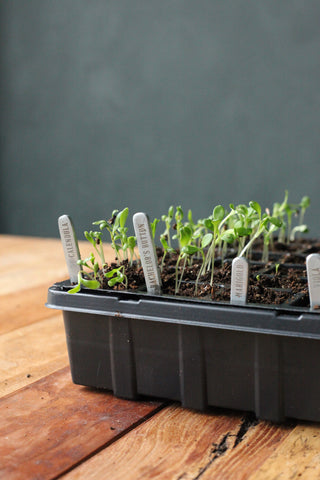
Using your metal garden markers, a pencil, or a finger, make a shallow indentation for your seed.
A good rule of thumb is to plant your seed as deep as its longest side. For the seeds we’re planting today – this isn’t deep at all.

STEP 4
Empty your seed pack into a dish for easy access and sprinkle a few seeds (2-3) into each cell.

STEP 5
Gently cover newly sown seeds with a dusting of seed starter mix.

STEP 6
Label each row with a garden marker.
Cover with your clear lid and set in a warm spot – near a radiator or even on a heating pad.

STEP 7
Your seeds are likely to sprout before watering is necessary, but check the soil every few days to make sure it hasn’t dried out. If water is necessary, bottom water to avoid disturbing the seeds.

STEP 8
Once the majority of the cells have sprouted seedlings, remove the cover and set the tray in a spot with bright light – or under a grow light.

STEP 9
Check on the seedlings frequently – daily or every other day, making sure that the soil stays moist.
If you are not using a grow light you will likely need to rotate your tray regularly to balance the lean of the seedlings towards the sun.

STEP 10
Once your seedlings begin to outgrow the tray, you can start the process of ‘hardening off’ or transitioning them outdoors – as long as there is no chance of frost. Set the tray outdoors, in a safe spot, for an increasing amount of time each day. Start with a couple hours on day one and gradually increase over the course of a week. Once they’re fully acclimated to the outside temperature, they can remain outdoors.
If it is not yet warm enough for this, gently poke them out of the tray and transplant with regular potting soil into larger pots. Move the pots as needed.

Share your garden progress with us. We’d love to see what you grow.
For more thoughts on garden planning, visit this post and keep an eye out for more tips and tricks.
]]>Grow your own cutting garden and surround yourself with color and texture, all season long. We’ve curated our selection of seeds with our favorites for floral arranging.
Want a few pointers on our favorite varieties? Scroll on.

We love late summer for flowers because there's so much local product available! Whether you're buying them at the farmers market or growing them yourself, zinnia is beloved because it's so easy to grow, has beautifully intricate eyes, and amazing variation in shape and color amongst a single variety. Zinnia Illumination is our favorite, and pairs perfectly with some of our tried and true juicy summer color palettes.

ZINNIA ILLUMINATION
zinnia elegans
Plant seeds into the garden after the last frost. When the soil is warm, sow thinly, six seeds per foot. Cover lightly but firmly. Keep surface from drying out until emergence. Thin after the first true leaves appear.
Harvest before flowers are completely open. Deadheading is necessary to prolong blooming and encourage branching. Zinnias should last 7-10 days in a vase.
height: 12-18”
light preference: Sun
germination: 3-5 days at 80-85°
plant spacing: 9-12”, 1/2” deep

Another easy-to-grow cutting garden favorite, we sell phlox seeds as a mix of pinks because we love every variety. We also love that it blooms and blooms in the garden until the first frost, has a sweet fragrance, and lasts an entire week as a cut flower! A perennial, phlox will spread easily and come back year after year.

MIXED PHLOX
phlox
Plant seed into the garden as soon as soil can be worked in spring. Cover seed with 1/2” fine soil. Darkness is required for germination. Thin when first true leaves appear.
Harvest when half of blooms on a stem are open. Expect a vase life of seven days.
height: 16-20”
light preference: Sun
germination: 5-10 days at 60-65°
plant spacing: 8-12"

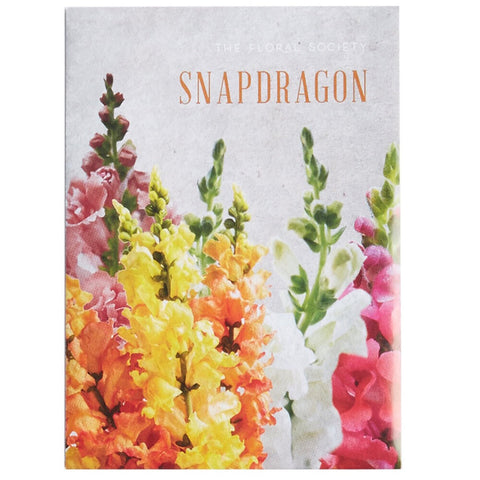
Just as lovely in a vase as they are in the garden, snapdragons are the perfect linear element in an arrangement with their ruffly faces and many blooms. They hold a place in our hearts for providing endless amusement as children; if you pinch their dragon face-like blooms laterally their little dragon mouths pop open!

SNAPDRAGON
antirrhinum majus
Start seeds indoors 8-10 weeks before the last frost, and transplant once the weather has warmed. Pinching encourages branching.
Harvest when florets on the lower 1/3-1/2 of the spike have just opened, before insects can pollinate them. They will last 7-10 days in a vase.
height: 28-26”
light preference: Sun/Partial Shade
germination: 7-14 days at 70-75°
plant spacing: 4-12”

Includes Zinnia, Larkspur, Forget-Me-Not, Cosmos, Sweet Sultans, Calendula, Feathered Celosia, Annual Baby's Breath, Indian Blank, Tricolor Daisy, and more. Perfect for the laissez-faire gardener, the annual flower mix is a great way to direct sow for a whole range of varieties and colors. We love tossing a few packs down in neglected areas of the garden and marveling at what emerges! It's also a wonderful way for a beginner gardener to get to know the different varieties.

ANNUAL FLOWER MIX
50 seeds — annuals
Select a sunny site of about 20 sq ft and prepare the soil, planting after the last frost. Combine seeds with a small container of sand and sprinkle over sowing area. Rake lightly and water.
height: Varied
light preference: Sun
germination: 5-21 days at 60-65°
plant spacing: 8-12”

Blue is a rare color in flowers, and forget-me-nots come in a most lovely delicate shade. With such an evocative name it's no wonder they are a treasured garden addition! They self-seed easily and prefer shaded moist locations, meaning that they'll happily ramble through ditches and boggy areas, bringing a little color to otherwise hard to use spots.

FORGET-ME-NOT BLUE
myosotis
Plant seed into the garden as soon as the soil can be worked easily. Cover seeds lightly with soil, as darkness is required for germination. Harvest when half of the flowers are open.
height: 18-24”
light preference: Sun/Partial Shade
germination: 5-8 days at 65-70°
plant spacing: 9-12”
Shop Individual Seeds, and our bestselling Edible Flower Seed Kit.
We want to see what you grow this season! Share with us
]]>